Taiyo Yuden 4.7nF MLCC, 25V dc V, ±10% , SMD
- RS Stock No.:
- 184-3448
- Mfr. Part No.:
- TMK063BJ472KP-F
- Brand:
- Taiyo Yuden

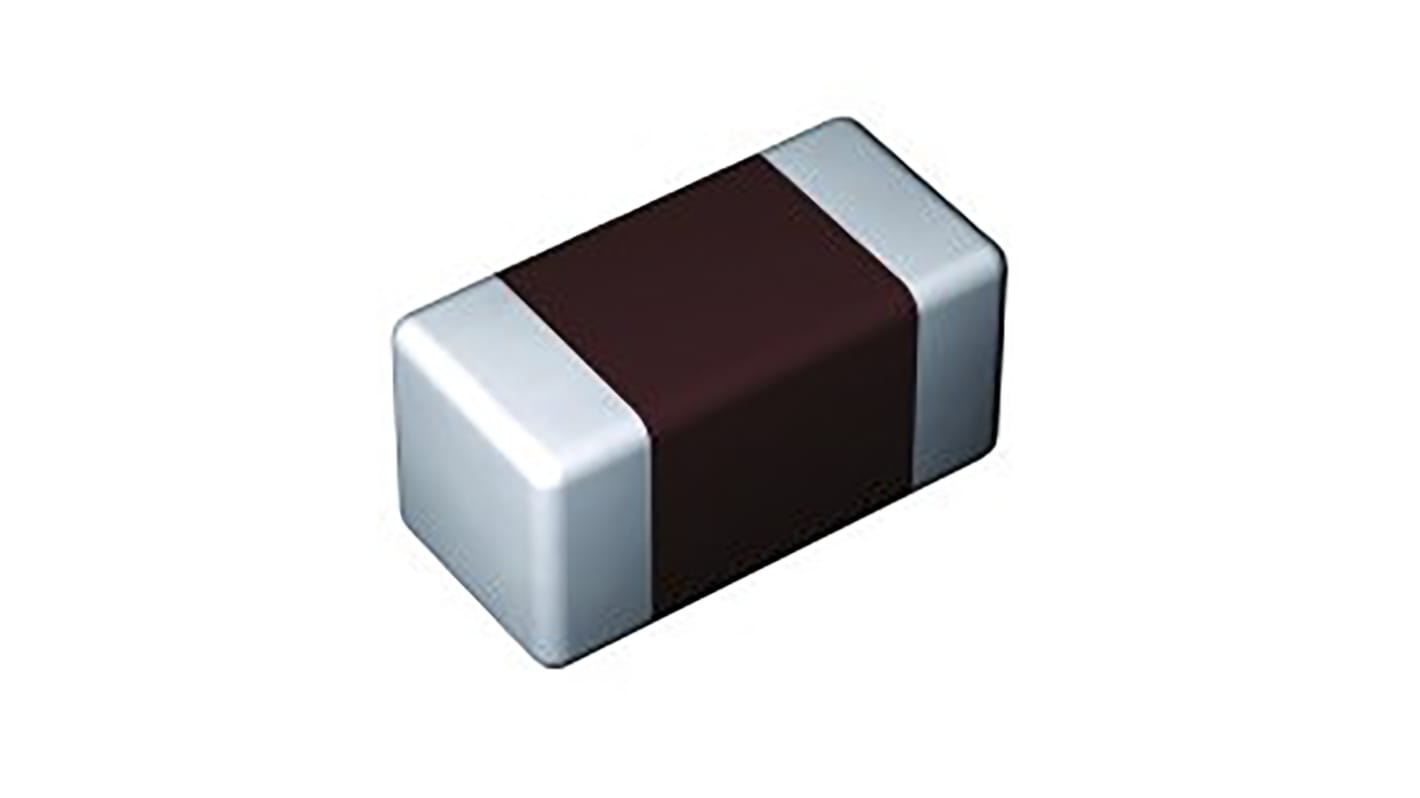
Currently unavailable
We don't know if this item will be back in stock, RS intend to remove it from our range soon.
- RS Stock No.:
- 184-3448
- Mfr. Part No.:
- TMK063BJ472KP-F
- Brand:
- Taiyo Yuden
Specifications
Technical data sheets
Legislation and Compliance
Product Details
Find similar products by selecting one or more attributes.
Select all | Attribute | Value |
|---|---|---|
| Brand | Taiyo Yuden | |
| Capacitance | 4.7nF | |
| Voltage | 25V dc | |
| Package/Case | 0201 (0603M) | |
| Mounting Type | Surface Mount | |
| Dielectric | X5R | |
| Tolerance | ±10% | |
| Dimensions | 0.6 x 0.3 x 0.3mm | |
| Length | 0.6mm | |
| Depth | 0.3mm | |
| Height | 0.3mm | |
| Series | M | |
| Terminal Type | Solder | |
| Minimum Operating Temperature | -55°C | |
| Maximum Operating Temperature | +85°C | |
| Select all | ||
|---|---|---|
Brand Taiyo Yuden | ||
Capacitance 4.7nF | ||
Voltage 25V dc | ||
Package/Case 0201 (0603M) | ||
Mounting Type Surface Mount | ||
Dielectric X5R | ||
Tolerance ±10% | ||
Dimensions 0.6 x 0.3 x 0.3mm | ||
Length 0.6mm | ||
Depth 0.3mm | ||
Height 0.3mm | ||
Series M | ||
Terminal Type Solder | ||
Minimum Operating Temperature -55°C | ||
Maximum Operating Temperature +85°C | ||
- COO (Country of Origin):
- JP
Taiyo Yuden Low Voltage M Series
Monolithic structure provides higher reliability. A wide range of capacitance values available in standard case sizes. The use of nickel as electrode material and plating processing improve the solderability and heat resistance characteristics. It also prevents migration and raises the level of reliability. Low equivalent series resistance(ESR) provides superior noise absorption characteristics.
Item Summary 4700 pF ± 10%, 25V, X5R/B, 0201/0603
Life cycle Stage Mass Production
Standard packaging quantity (minimum) Taping paper 15000pcs
Applications
Communication equipment (cellular phone, wireless applications, etc.)
General digital circuit
Power supply bypass capacitors: Liquid crystal modules, Liquid crystal drive voltage lines, LSI, IC, converters (both for input and output)
Smoothing capacitors: DC-DC converters (for both input and output), Switching power supplies (secondary side)
Life cycle Stage Mass Production
Standard packaging quantity (minimum) Taping paper 15000pcs
Applications
Communication equipment (cellular phone, wireless applications, etc.)
General digital circuit
Power supply bypass capacitors: Liquid crystal modules, Liquid crystal drive voltage lines, LSI, IC, converters (both for input and output)
Smoothing capacitors: DC-DC converters (for both input and output), Switching power supplies (secondary side)
0201 Range
Nickel barrier terminations covered with a layer of plated Tin (NiSn)
Applications include mobile phones, video and tuner designs
C0G/NP0 is the most popular formulation of the "temperature compensating", EIA Class I ceramic materials
X7R, X5R formulations are called "temperature stable" ceramics and fall into the EIA Class II materials
Y5V, Z5U formulations are for general purpose use in a limited temperature range, EIA Class II materials; these characteristics are ideal for decoupling applications.
Applications include mobile phones, video and tuner designs
C0G/NP0 is the most popular formulation of the "temperature compensating", EIA Class I ceramic materials
X7R, X5R formulations are called "temperature stable" ceramics and fall into the EIA Class II materials
Y5V, Z5U formulations are for general purpose use in a limited temperature range, EIA Class II materials; these characteristics are ideal for decoupling applications.
Related links
- Taiyo Yuden 4.7nF MLCC SMD
- Taiyo Yuden 4.7nF Multilayer Ceramic Capacitor MLCC ±10% , SMD
- Taiyo Yuden 10nF MLCC ±10% , SMD
- Taiyo Yuden 100nF MLCC ±10% , SMD
- Taiyo Yuden 1μF Multilayer Ceramic Capacitor MLCC ±10% , SMD
- Taiyo Yuden 2.2μF MLCC ±10% , SMD
- Taiyo Yuden 100nF MLCC ±10% , SMD
- Taiyo Yuden 2.2nF MLCC ±10% , SMD