Grabber & Hook Clips
Grabber clips and hook clips, also known as grabber hook, hook on clips or clipping hook, are essential non-permanent electrical test accessories used to establish secure, hands-free connections to circuit test points, components, or terminals.
Typically consisting of a spring-loaded shaft, a miniature hook clamp mechanism, and often a wire connection point (such as a banana jack or solder cup), they allow technicians to reliably access signals for measurement without shorting adjacent components.
These versatile tools play a crucial role in test and measurement setups, ensuring a stable connection required for accurate diagnostics and prototyping.
Types of Grabber and Hook Clips
There are a variety of grabber clips and hook clips available to meet the diverse mechanical and electrical requirements encountered in electronics testing, ranging from fine-pitch components to heavier terminals.
Miniature Grabber Clips
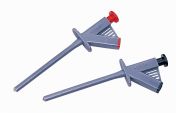
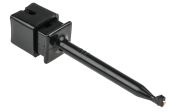
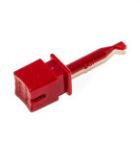
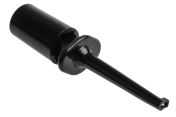
These tiny grabber clips feature a fine, multi-pronged jaw designed for attaching to very small component leads, IC pins (DIP/SOP), or surface-mount test points. Their compact size and lightweight construction minimise mechanical stress on delicate PCB traces and components, making them ideal for precise, high-density probing where a standard hook with clip would be too large.
Insulated Hook Clips
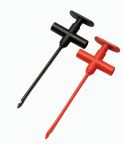
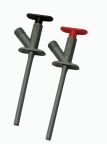
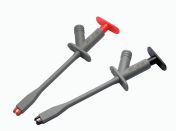
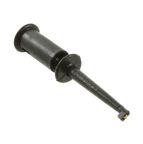
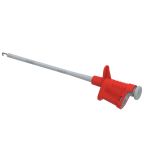
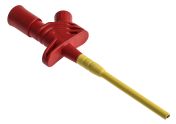
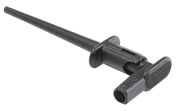
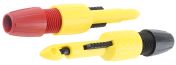
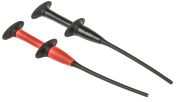
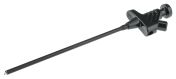
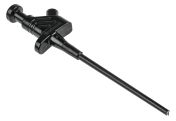
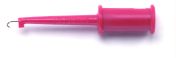
Insulated hook clips feature a spring-loaded, retractable hook clamp that opens to latch securely onto terminals, component leads, or wire insulation. The hook clip mechanism is fully protected by plastic insulation, reducing the risk of accidental short circuits to adjacent points or contact with the user, enhancing safety during live circuit testing.
Heavy-Duty and Large Jaw Grabbers
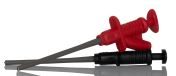
Designed for use with larger conductors, battery terminals, or heavy-gauge wires, these grabber clips (sometimes referred to as a clipping hook or larger grabber hook) offer a more robust spring force and larger jaw capacity. They are often rated for higher current applications, providing a secure, low-resistance connection for power supply testing and automotive diagnostics.
Lead Wire Assemblies
Many hook clips and grabber clips are supplied pre-assembled onto test leads terminated with common test connectors like banana plugs or BNC connectors. These integrated assemblies ensure a low-noise, reliable electrical path from the test point (via the hook on clips) directly to instruments like oscilloscopes or multimeters.
Key Features and Benefits of Grabber and Hook Clamps
Grabber clips and hook clips offer numerous features that make them essential tools in electronic testing, providing secure connections and enhancing the safety and efficiency of measurement tasks. Their design is optimised for hands-free operation and reliable signal capture.
- Secure, Hands-Free Connection: The spring-loaded mechanism ensures a positive and secure grip on the test point, allowing technicians to perform measurements hands-free, reducing the risk of accidental disconnection or shorting.
- Insulation and Safety: Virtually all modern hook clips are fully insulated, protecting the conductive material and limiting the exposed metallic surface area. This critical feature significantly enhances user safety and prevents short circuits.
- Versatile Probing Capability: Different sizes, from miniature fine-wire grabs to large grabber hook terminals, enable technicians to connect accurately to a wide range of component sizes and test surfaces. The versatility eliminates the need for soldering temporary leads.
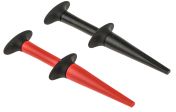
- Colour-Coding: Most grabber clips and accessories are colour-coded (typically red, black, yellow, blue, and green) to easily identify and manage signal lines, polarity, and circuit points. This simplifies setup and helps prevent cross-connection errors.
Factors to Consider When Choosing Grabber and Hook Clips
Selecting the appropriate grabber clips or hook on clips is all about matching the device's mechanical and electrical characteristics to the testing environment and the components being probed.
- Jaw Size and Tip Type: The size and profile of the clipping hook or grabber jaw must be compatible with the component being tested.
- Electrical Rating (Voltage and Current): Always verify that the hook clip is rated for the maximum voltage and current of the circuit being tested. Underrated clips can pose a significant safety risk.
- Connection Method: Determine how the grabber hook attaches to the test lead, which is typically via a solder bucket, crimp, or a standard connection point like a 4mm banana jack.
- Insulation Material and Thickness: For high-voltage applications, ensure the insulation material and thickness meet strict safety standards, such as IEC 61010's Category (CAT) ratings in New Zealand (NZ). The specified CAT rating (e.g., CAT II, CAT III, CAT IV) dictates the maximum transient voltage the hook clip can safely handle in different installation environments.
- Ergonomics and Spring Tension: The feel and ease of operation of the hook clip actuator are important for technician comfort during prolonged testing sessions. Spring tension should be firm enough to ensure a secure grip without damaging delicate components.
Applications of Grabber & Hook Clips
Grabber clips and various hook clips are indispensable tools in electrical and electronic engineering, offering flexible and reliable connection points across numerous stages of design, testing, and maintenance. Here are some of their applications:
- Circuit Prototyping and Testing on Breadboards: Miniature grabber clips are ideal for connecting instrumentation (like multimeters or logic analysers) to individual component leads or test points on breadboards or prototyping boards without requiring soldering.
- Laboratory and Bench Measurement Setups: Used extensively in R&D and educational environments to create temporary, secure test connections from oscilloscopes or function generators to a Unit Under Test (UUT) using a reliable hook with clip mechanism.
- Fault-Finding in Wiring/Harnesses: Larger hook clips and hook clamps allow technicians to quickly tap into wiring looms and vehicle harnesses to diagnose intermittent faults or monitor signal lines safely, often when power is still applied.
- Use in Cable/PCB Testing Rigs: Incorporated into custom fixtures and test jigs, a durable clip grabber or hook on clips ensures consistent mechanical and electrical contact for performing continuity checks or functional tests on batches of cables or populated PCBs.
- Debugging, Signal Tapping: Hook clips are essential for non-intrusively “tapping” into digital or analogue signal lines for real-time analysis during the debugging phase, providing a stable connection point for data acquisition without modifying the circuit.
Order Grabber and Hook Clips from RS
RS is a trusted supplier and distributor of grabber clips and hook clips in New Zealand (NZ). Our range includes grabber hooks from leading brands like Hirschmann Test & Measurement, Mueller Electric, and Schutzinger in a variety of colours, contact material, current rating, length, insulation material, safety categories and many more.
Besides grabber and hook clips, we also offer other products for your testing and diagnostic needs like crocodile clips, banana connectors, test probes and many more.
View our extensive catalogue today and visit our delivery page for more information on delivery options and fees.
Related links
- Keysight Technologies Black/Red Grabber Clip 300V
- Staubli Black Grabber Clip with Pincers 300V, 2mm Socket
- SAM Black Grabber Clip, 2mm Socket
- Schutzinger Grabber Clip with Crocodile Jaws
- Fluke Black 1A, 1kV
- Hirschmann Test & Measurement Red Hook Clip with 50V, 4mm Socket
- Fluke Red/Black Hook Clip with , 3A
- Staubli Black Grabber Clip with Pincers 1kV, 4mm Socket