- Published 30 Oct 2026
- Last Modified 30 Oct 2026
- 9 min
What Is a PLC? A Complete Guide to Programmable Logic Controllers
Programmable Logic Controllers (PLCs) are a key component in many industrial activities. Find out how they work, the different types available, how they are programmed and their specific use cases in this guide.


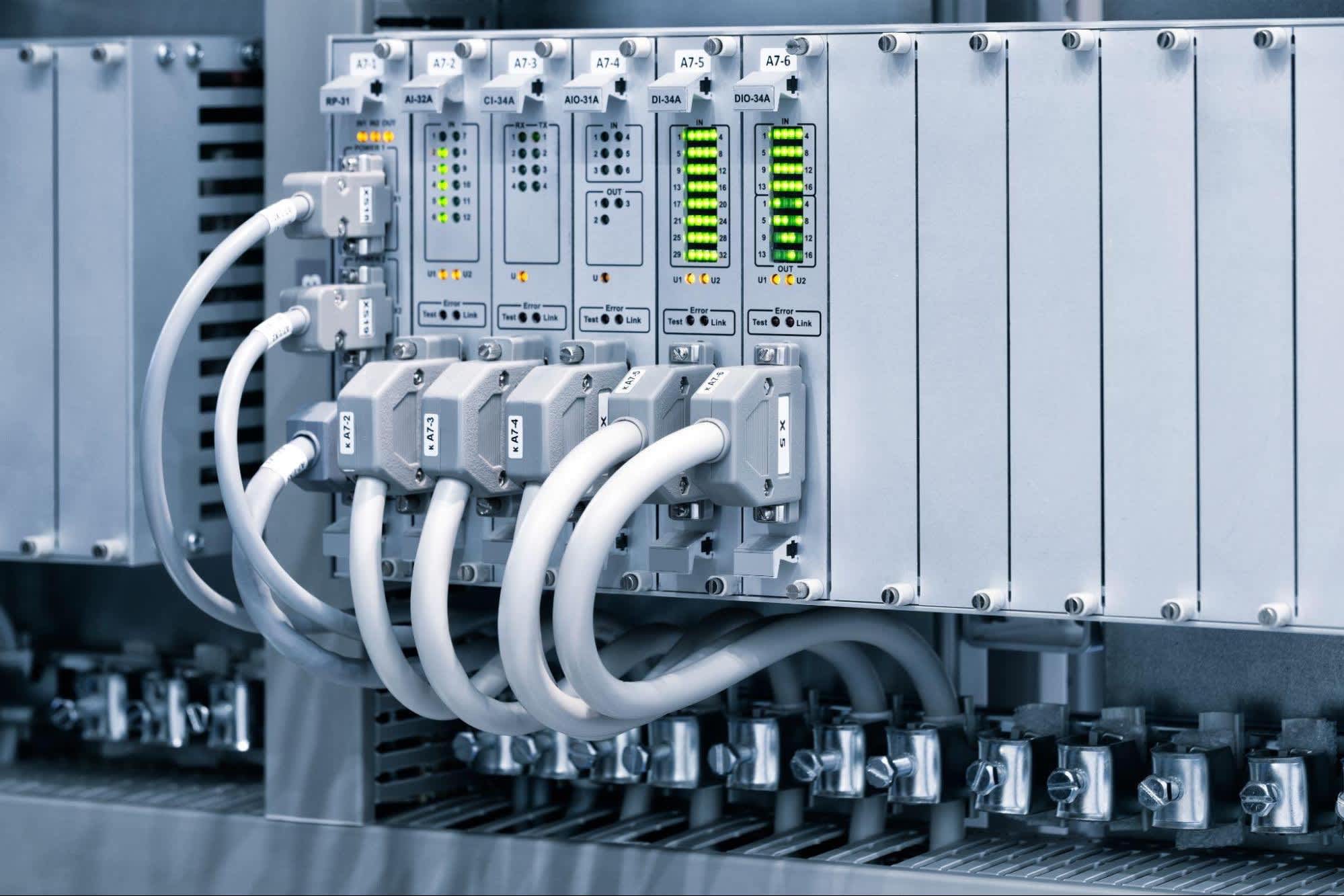
A programmable logic controller (PLC) is a rugged industrial computer that monitors inputs from sensors and switches and controls outputs such as motors, valves and lights according to a stored program. PLCs replaced hard-wired relay panels from the 1960s onwards and now run automated machinery across manufacturing, food processing, water treatment and building services sites in New Zealand. This guide covers how programmable logic controllers work, their main components, the main types, how they are programmed, their main applications and the advantages of a PLC over older control methods.
How Do PLCs Work?
A PLC works in a continuous loop called the scan cycle:
- Input Scan: The CPU reads all connected inputs (sensors, switches, pushbuttons, analogue signals) and stores the values in an input image table.
- Program Execution: The processor runs the user program against those input states, applying the control logic that defines how the machine responds.
- Output Update: The PLC updates the output image table and switches physical outputs (motors, valves, lights, drives) based on the result.
- Housekeeping: The CPU handles communications, diagnostics and self-checks before the next cycle starts.
The cycle typically repeats many times per second, with scan times of 1-10 milliseconds common on modern PLCs. Scan time matters for fast signals such as safety inputs or high-speed count pulses that must be caught before the next event occurs.
As a worked example, picture a bottle moving down a conveyor on a NZ bottling line:
- Input: The bottle passes a sensor and closes an input contact on the PLC.
- Program: On the next scan, the program recognises the input and decides a fill cycle is due.
- Output: On the output update, the PLC opens a fill valve for the configured time, then closes it.
Digital I/O carries on/off states (a limit switch is open or closed), while analogue I/O carries variable values such as 4-20 mA signals from a pressure sensor on a tank or 0-10 V outputs to a variable speed drive running a pump.
Main Components of a PLC
A PLC is built from a standard set of hardware blocks:
Component | What it does |
|---|---|
| CPU (Processor) | Runs the user program each scan cycle and manages the overall operation of the PLC. |
| Power Supply | Converts mains or control-voltage input into the regulated DC rails the CPU and modules need, typically 24 V DC from a DIN rail power supply. |
| Input Modules | Receive signals from field devices such as sensors, switches, encoders and transmitters, and present them to the CPU as scaled values. |
| Output Modules | Switch loads such as motors, valves, lights and drives using relay, transistor or triac outputs matched to the load. |
| Memory | Holds the running program, the input and output image tables, data registers, timers and counters. |
| Communication Ports and Modules | Carry Ethernet, serial and fieldbus traffic between the PLC, HMIs, drives and other PLCs. |
| Programming Device | A PC running the manufacturer's engineering software, used to write, download, monitor and debug the program. |
On compact PLCs, these components sit in a single housing; modular PLCs mount each one on a rack or DIN rail, so modules can be added or replaced as the plant grows.
How PLCs Work with HMIs and SCADA
An HMI (human-machine interface) is the operator touchscreen connected to the PLC, giving plant staff a view of the running process, alarms and manual controls. SCADA (supervisory control and data acquisition) systems sit above a group of PLCs across a site, collecting data, logging events and providing central visibility for engineers and operators.
Types of PLCs
PLCs are most commonly grouped by hardware format: compact (fixed), modular, soft and safety.
Compact (Fixed) PLCs
Compact PLCs integrate the CPU, I/O, power supply and communications into a single fixed housing with a modest, non-expandable I/O count. They suit standalone machines, pump stations and small OEM equipment where cost and footprint matter more than future expansion.
Modular PLCs
Modular PLCs plug the CPU, power supply and I/O modules into a rack, backplane or DIN rail, so the system is configured and later expanded by adding or replacing modules. Large rack-mounted systems are themselves a form of modular PLC, scaled up for production lines and plant-wide control.
Soft PLCs
Soft PLCs run the control logic as software on an industrial PC or embedded controller rather than dedicated PLC hardware. They suit applications that mix control logic with data processing, HMI, vision or motion in a single platform.
Safety PLCs
Safety PLCs are certified controllers designed for emergency stop, light curtain, interlock and guarding functions in machinery and process safety. They use redundant internal architecture and diagnostics to meet SIL and PL ratings, and can be dedicated units or safety-capable modules in a modular rack.
Type | Expandable? | Typical application size | Strengths | Typical use |
|---|---|---|---|---|
| Compact (Fixed) | No | Small (standalone machine) | Low cost, small footprint, quick to deploy | Pump stations, small OEM equipment, single machines |
| Modular | Yes | Medium to large (lines and plants) | Scalable I/O, mix of module types, long product lifecycle | Production lines, plant-wide control, process skids |
| Soft | Yes (via PC hardware) | Varies (data-heavy) | Combines control with vision, motion and data in one platform | Industrial PCs running mixed-mode applications |
| Safety | Yes (safety-rated modules) | Any (safety-critical) | Certified for functional safety, redundant architecture | E-stop circuits, guarding, light curtains, interlocks |
How Are PLCs Programmed?
PLCs are programmed on a PC using the manufacturer's engineering software (Siemens TIA Portal, Rockwell Studio 5000, Mitsubishi GX Works, Omron Sysmac Studio and so on), and most support the languages defined in the international standard IEC 61131-3.
The current fourth edition of the standard (IEC 61131-3:2025, published May 2025) defines four languages; a fifth language, Instruction List (IL), was deprecated in the third edition (2013) and formally removed in the fourth edition, though it still appears in legacy software.
Language | Format | Best suited for |
|---|---|---|
| Ladder Diagram (LD) | Graphical | Discrete control, interlocks and electrical-mindset engineers |
| Function Block Diagram (FBD) | Graphical | Process control, motor control and dataflow logic |
| Structured Text (ST) | Text | Complex calculations, loops and conditional logic |
| Sequential Function Chart (SFC) | Graphical (with text actions) | Batch sequences and process stages (state machines) |
Ladder logic is the most widely used because it mirrors the relay circuit diagrams that pre-date PLC-based control, giving maintenance electricians a familiar read.
What Are PLCs Used For?
PLCs are used wherever a machine or process needs reliable, repeatable automatic control. The main applications of PLCs across NZ sites include:
- Manufacturing and Assembly Lines: PLCs control conveyors, robotic cells, part counting, pick-and-place machinery and quality inspection stations across discrete manufacturing.
- Food, Beverage and Dairy Processing: PLCs run filling machines, pasteurisation cycles, CIP (clean-in-place) sequences and recipe management.
- Packaging Machinery: PLCs coordinate wrap, seal, labelling and case-packing lines, synchronising servo drives and conveyors.
- Water and Wastewater Treatment: PLCs manage lift and transfer pumps, dosing systems, tank levels and SCADA-reported events across municipal and industrial water sites.
- Building Services: PLCs run HVAC plant, lift and escalator control, lighting zones and access-control integrations in commercial buildings and large facilities.
- Agriculture and Horticulture: PLCs control irrigation scheduling, dairy milking parlour sequences and greenhouse climate systems across NZ farms and growers.
- Energy and Utilities: PLCs manage generator start and stop sequences, automatic transfer switches, solar inverter farms and battery energy storage systems.
Advantages of Programmable Logic Controllers
PLCs replaced hard-wired relay panels because they offer a long list of advantages over the older approach:
- Easy Reprogramming: Logic changes are made in software and downloaded to the PLC, without rewiring the control panel each time a sequence or interlock is updated.
- Ruggedness and Reliability: PLCs are built for industrial environments and tolerate the heat, vibration, dust and electrical noise that would quickly damage office computers.
- Real-Time Deterministic Control: The scan cycle gives predictable response times engineers can measure and rely on for machinery timing.
- Built-In Diagnostics: Fault indicators, diagnostic registers and online monitoring tools from the engineering software make faults faster to find and clear.
- Scalability: Modular I/O lets the system grow as the plant expands, without replacing the controller itself.
- Connectivity: PLCs integrate with HMIs, SCADA, industrial networks and ERP systems via Ethernet cable and fieldbus protocols, feeding plant data into the wider business.
PLC vs Hard-Wired Relay Logic: A Quick Comparison
Dimension | PLC | Hard-Wired Relay Logic |
|---|---|---|
| Flexibility | Logic changes made in software and downloaded in minutes | Logic changes require physical rewiring of the control panel |
| Wiring | I/O terminated once; internal logic lives in the program | Every logic branch is a physical wire between relay contacts |
| Fault finding | Diagnostic LEDs, online monitoring and status registers | Trace signals manually across contacts and relay coils |
| Footprint | Compact DIN-rail module or rack handles hundreds of I/O | Grows with the logic; large panels for complex sequences |
| Upfront cost | Higher hardware cost, lower install and lifecycle cost | Lower hardware cost, higher install and change cost |
The main limitations are that engineering software is proprietary and brand-specific, and that very simple on/off tasks (a single interlock) or heavy data-processing workloads can be a poor fit for a dedicated PLC.
PLC Brands Available at RS
RS NZ stocks PLCs from the major industrial automation brands used across New Zealand plants and OEM machinery builders:

Siemens
Siemens SIMATIC S7 PLCs (S7-1200, S7-1500) are the global standard in European-engineered machinery and process plants, programmed in TIA Portal.

Omron
Omron CJ, CP and NX series controllers appear across packaging, food processing and OEM machinery.

Schneider Electric
Schneider Electric Modicon M221, M241 and M580 PLCs run building services, water treatment and OEM applications.

Mitsubishi Electric
Mitsubishi Electric MELSEC FX5U, Q and iQ-R series PLCs are widely used in Japanese and Asian OEM machinery, with strong adoption in automotive, electronics assembly and precision manufacturing plants.
Frequently Asked Questions About PLCs
Shop PLCs and Accessories at RS
Browse RS New Zealand's range of PLCs across compact, modular, soft and safety-rated controllers from the leading industrial automation brands, with plug-in accessories, HMI displays and 24V DIN rail power supplies on the same catalogue to complete a control-panel build in one order.
Related Links

What Is a Photoelectric Sensor? A Complete Guide
Learn all about photoelectric sensors in this guide. We explore how they work, the different types available, how they’re used as well as their advantages and limitations.

What Is a PLC? A Complete Guide to Programmable Logic Controllers
Programmable Logic Controllers (PLCs) are a key component in many industrial activities. Find out how they work, the different types available, how they are programmed and their specific use cases in this guide.