Serial Cables
Serial cables are components in data communication systems, facilitating reliable, point-to-point data transmission across a wide range of industrial, commercial, and legacy computing environments. Unlike parallel transmission, which sends multiple bits simultaneously, serial communication transfers data one bit at a time, making it more suitable for longer distances and electrically noisy environments.
One of the most widely used standards is the Recommended Standard 232 (RS-232) interface cable, which governs the mechanical, electrical, and functional characteristics of serial communication interfaces. Whether used to connect programmable logic controllers (PLCs), CNC machines, or test equipment, RS-232 serial cables offer a proven solution for maintaining dependable communication between devices.
How Is an RS-232 Cable Made?
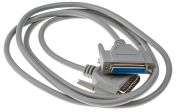
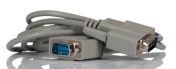
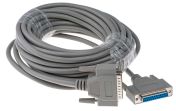
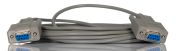
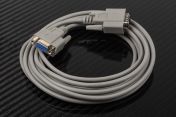
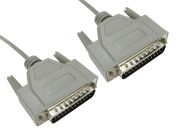
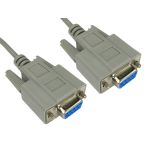
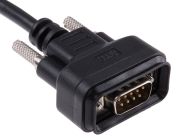
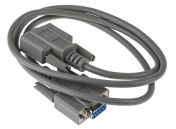
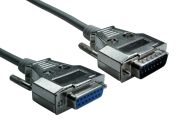
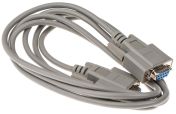
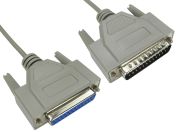
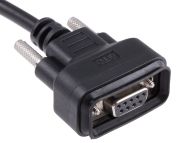
An RS-232 serial cable is typically constructed using shielded, multi-core cabling to protect against electromagnetic interference (EMI), a common challenge in industrial environments. At each end, the cable is terminated with D-subminiature connectors, most commonly DB9 connectors (9-pin) or DB25 connectors (25-pin), which are available in both male and female formats.
Internally, the cable consists of insulated conductors twisted into pairs to maintain signal integrity. A protective foil or braided shield surrounds the conductors, helping to minimise signal degradation over distance. Many variants also include a drain wire for improved grounding and strain relief mouldings to reduce mechanical stress and prevent conductor fatigue.
Types Of Serial Cables
Serial cables come in several configurations, each designed to support different communication standards, distances, and environments. Understanding the distinctions between cable types ensures optimal performance and compatibility.
RS-232 Serial Cables
These are the most commonly used interface cables, designed specifically for communication under the RS-232 protocol. Typically limited to a distance of 15 metres, they are ideal for connecting computers to peripherals, diagnostic equipment, and automation controllers. Their simplicity and widespread compatibility make them the industry standard for communicating with legacy systems.
RS-422 Serial Cables
Offering improved speed and longer range over RS-232, RS-422 cables support differential signalling. These are commonly used in industrial environments that require communication over distances up to 1,200 metres. A single transmitter can drive multiple receivers, making this type ideal for unidirectional bus configurations.
RS-485 Serial Cables
Engineered for multi-point communication, RS-485 cables allow up to 32 devices to be connected on the same bus. These are widely deployed in building automation, HVAC control, and factory automation due to their ability to tolerate unwanted electrical signals (noise immunity) and ability to transmit over long distances in harsh environments.
USB To Serial Adapters
Modern PCs and laptops mostly use USB ports, a standardised port for peripherals. USB to serial adapters enable compatibility with serial-enabled equipment by converting USB signals into RS-232 cable protocols. These are particularly useful for technicians working on-site with legacy systems or embedded devices.
Null Modem Cables
Null modem cables reverse the transmit and receive lines in a typical RS-232 connection to allow two Data Terminal Equipment (DTE) devices to communicate directly. These are useful in scenarios where a modem is not required, such as direct PC-to-PC communication or firmware updates between embedded systems.
Key Features Of Serial Cables
Serial cables are engineered with specific features to ensure reliable data transmission across industrial and commercial applications. Some of their key attributes are:
- Connector Types: Available with DB9 cable connectors, DB25, and USB connectors in male/female or mixed formats.
- Shielding: Aluminium foil or braided shielding provides resistance to electromagnetic interference (EMI), essential in electrically noisy environments.
- Durability: Ruggedised jackets and strain relief boots extend service life in high-use or mobile applications.
- Length Options: Ranges from 0.5 metres for localised connections to 15 metres or more for extended distances.
- Compatibility: Designed to work with a wide range of legacy and current devices.
Factors To Consider When Choosing The Right Serial Cable
Selecting the right serial cable depends on your application’s protocol requirements, connector types, cable length, shielding level, and environmental conditions. Ensuring alignment with these factors helps maintain signal integrity, system compatibility, and long-term performance.
- Determine the protocol: Ensure the cable supports your specific protocol, be it RS-232, RS-422, or RS-485.
- Select the connector type: Choose the appropriate DB9, DB25, or USB connector based on your device interface.
- Consider cable length: Ensure the cable length matches the required application without compromising signal quality.
- Check shielding and durability: Look for well-shielded, industrial-grade cables if the environment involves electrical noise or physical stress.
- Environmental conditions: Evaluate temperature ranges, moisture exposure, and flexibility based on field conditions.
Applications Of Serial Cables
- Industrial automation: Used to connect PLCs, HMIs, and sensors for real-time control and monitoring.
- Scientific instruments: Enable data acquisition and control in laboratory environments, especially in calibration and metrology applications.
- Point of sale systems: Provide reliable communication between terminals, receipt printers, and barcode scanners via an RS-232 interface.
- Consumer electronics: Support legacy communication standards in devices such as modems and gaming controllers.
- Broadcast & AV equipment: Facilitate remote control of video switchers, projectors, and pan-tilt-zoom (PTZ) cameras using serial cables.
The Trusted Supplier and Distributor of Serial Cables in New Zealand
RS New Zealand is your dependable source for high-performance serial cables built for demanding industrial, automation, and data communication environments. From factory floors and test labs to field service operations, our range supports reliable device connectivity across varied applications.
We also stock cable-related peripherals like heat-shrink tubing, heavy-duty cable ties, and cable trunking. RS New Zealand is a trusted supplier and distributor of serial cables, offering a comprehensive range from industry-leading manufacturers such as RS PRO, Phoenix Contact and L-Com.
Browse and order online with ease via the RS New Zealand website. For details on local delivery options, lead times, and support, please visit our delivery information page.
Related links
- StarTech.com Male 9 Pin D-sub to Male 3.5mm Stereo Jack Serial Cable, 1m PVC
- L-Com Female DB9 to Female DB9 Serial Cable CRM Series
- A Comprehensive Guide to Serial Cables
- L-Com Male DB9 to Male DB9 Cable assembly, 10ft LSZH
- L-Com Male DB9 to Female DB9 Serial Cable CSM Series
- StarTech.com Female 9 Pin D-sub to Male 9 Pin D-sub Serial Cable, 3m PVC
- L-Com Female DB9 to Female DB9 Cable assembly, 5ft PVC
- L-Com Male DB9 to Female DB9 Serial Cable CPM Series