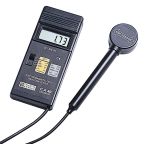
Gaussmeters
A gaussmeter, also known as a gauss meter or magnetometer, is a precision instrument designed to measure the strength and direction of magnetic fields. These devices are essential for a wide array of applications in various industries, from ensuring quality control in manufacturing to conducting critical research in scientific laboratories.
Whether you need to detect residual magnetism, verify the strength of permanent magnets, or monitor electromagnetic fields (EMF), a reliable gaussmeter provides accurate data crucial for product performance, safety, and regulatory compliance.
How Do Gaussmeters Work?
A gauss meter detects magnetic field strength via a Hall effect sensor, which generates a voltage in response. This voltage is processed into a digital reading, typically shown in Gauss (G) or Tesla (T).
Advanced magnetic gauss meters also determine field direction using orthogonal sensors. As a gaussmeter moves closer to a magnetic source, the reading increases; and decreases when moving away.
Environmental factors—such as the Earth's magnetosphere, solar activity, or nearby magnetic materials—can influence measurements. For accurate, low-frequency EMF monitoring, an EMF gauss meter is recommended.
How to Use A Gaussmeter
Here's a general guide:
- Power On and Calibrate: Turn on your gaussmeter and allow it to warm up. Perform a zero-field calibration to ensure accurate readings.
- Select Measurement Range: Choose the appropriate range on your gauss meter based on the expected magnetic field strength. Start high and adjust down to prevent sensor overload.
- Probe Placement: Position the gaussmeter probe perpendicular to magnetic field lines for best accuracy. For surface measurements, place the probe directly on the material.
- Take Readings: Observe the display for stable readings on static fields or peak/RMS values for dynamic fields. Record data as needed for your application.
- Consider Environmental Factors: Be aware of nearby magnetic sources that can interfere with readings. Measure in a controlled environment when possible to minimise interference.
Types of Gaussmeters
Gaussmeters are broadly categorised based on the type of magnetic field measurement they provide.
Scalar Gauss Meters
Scalar gauss meters measure only the magnitude of the magnetic field at a specific point. These are ideal for quick inspections and general-purpose applications.
They are commonly used to test magnet strength or detect residual magnetism in industrial tools.
Vector Gauss Meters
Vector gaussmeters measure both the strength and direction of magnetic fields. They do this by evaluating the field along multiple axes.
These are suitable for complex scenarios such as magnetic field mapping, interference studies, and advanced R&D.
Factors to Consider When Choosing the Right Gaussmeter
When selecting a gaussmeter in NZ, consider the following:
- Determine Your Application: Are you measuring DC (static), AC (alternating) or EMF? Choose a magnetometer accordingly.
- Measurement Range: Ensure the gaussmeter covers the expected field strengths. Different models offer various ranges (e.g., milligauss, kiloGauss).
- Accuracy & Resolution: Important for precision tasks in labs or quality control.
- Frequency Response: Confirm the device's ability to detect AC field variations.
- Display & Interface: Look for clear displays, peak-hold, and data logging features.
- Probe Type: Different probes are designed for specific applications (e.g., axial probes for measuring along a magnet's axis, transverse probes for perpendicular measurements, thin probes for tight spaces).
- Portability: If you need to take measurements in various locations, a handheld magnetometer is essential for ease of transport and field use.
- Budget: While a higher magnetometer price often correlates with greater accuracy and features, assess your budget against the necessary capabilities. For those looking for magnetometers for sale in NZ, various options exist across different price points.
Applications of Magnetic Gauss Meter
Magnetic gauss meters and magnetometers are invaluable tools with diverse applications across numerous industries:
- Electronics Manufacturing: Detects residual magnetism or verify magnet strength in speakers, motors, and sensors.
- Automotive Industry: Measure magnetic fields in sensors, motors, and components.
- Medical Equipment: Support MRI calibration and EMF compliance testing.
- Research & Development: Ideal for testing materials or prototyping magnetic devices.
- Environmental Monitoring: Assess EMF levels using an EMF gauss meter.
Secure Your Gaussmeter Online from RS NZ
Browse RS New Zealand’s full range of gaussmeters from trusted global brands like RS PRO, Hirst Magnetics and Chauvin Arnoux. Beyond gaussmeters, our comprehensive inventory includes essential industrial tools like proximity sensors, hydrometers and ultrasonic water leak detectors.
RS New Zealand is proud to offer reliable local service and fast fulfilment across the country. Streamline your procurement process by placing orders directly through our secure website. For complete service and delivery details, please refer to our dedicated delivery informationpage.